One way to store electricity are batteries. In South Australia, giant batteries have started to be installed, including the 52Mwh battery at Lake Bonney in South Australia at a cost of $A38M. This works out at about $A730/KWh.
At these sort of rates and without smart metering becoming more wide-spread, batteries would be too expensive for mass storage of electricity. They are however useful to keep the grid stable. This is necessary because events such as clouds moving over a major photovoltaic installation can be quite disruptive to the grid.
Hydroelectric energy generation is the conversion to electricity of the energy that is released when water moves from a greater height to a lower height, typically from a higher reservoir to a lower river or reservoir.
This process can also work in reverse when spare energy is used to pump water from a lower reservoir to a higher reservoir. That is the principle of hydro-electric storage. It's a proven technology.
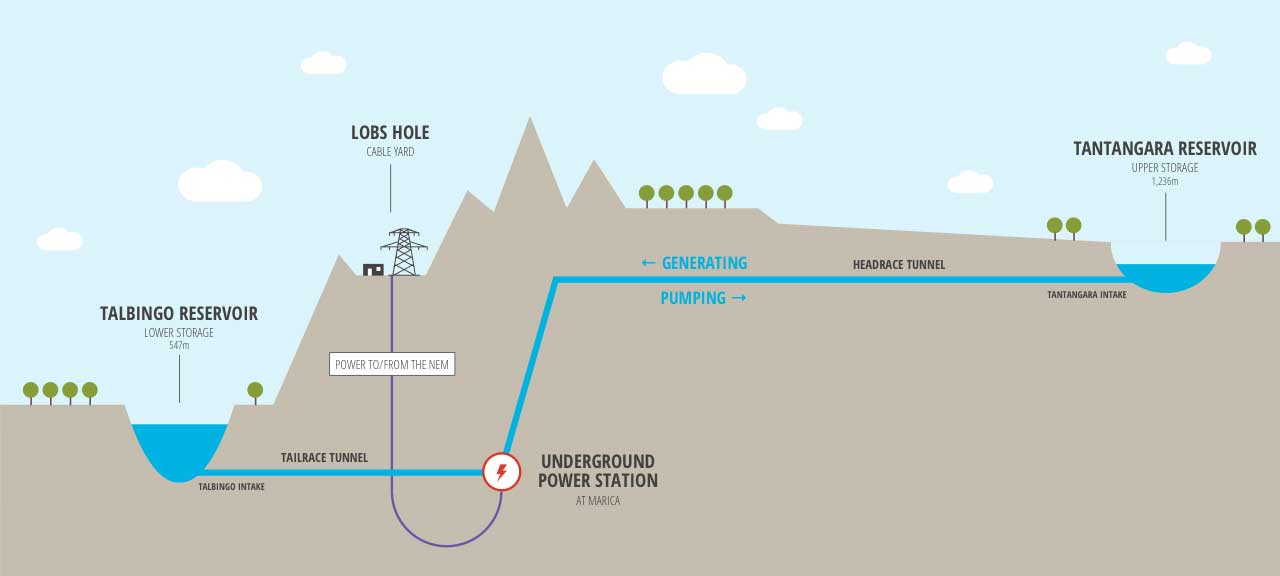
The greatest such project being planned in Australia is the Snowy Hydro 2.0 scheme. The Coalition government announced this initiative in 2017. In the words of the Snowy Hydro corporation: Snowy 2.0 will provide an additional 2,000 megawatts (MW) of dispatchable generating capacity and approximately 350,000 megawatt hours (MWh) of large-scale storage. That's about 14 KWh per inhabitant of Australia.
It is unclear how much this project will cost. The official estimate is around $A 5 Billion but there are suggestions that this might blow out to $A 10 Billion. But even at $A 10 Billion that is less than $A30 per KWh of storage.
The graphic below is from the Snowy Hydro Corporation site