Temperature measurements are showing a trend towards higher temperatures. However as measurements are taken from many different locations on earth by many different teams, it can happen that here or there something questionable happens. That's enough for climate change deniers to attack and muddy the waters. So I am going to look at other evidence.
We have the following text from the Australian Academy of Science:
For two thousand years before the mid-19th century, the long-term global sea-level change was small, only a few centimetres per century. Since then, the rate of rise has increased substantially; from 1900 to 2012, sea level rose by a global average of about 19 centimetres. In the past 20 years, both satellite and coastal sea-level data indicate that the rate of rise has increased to about 3 centimetres per decade. A similarly high rate was experienced in the 1920 to 1950 period.
There are numerous stories and anecdotes about sea level rises affecting low-lying populated areas. For example this story from 2018-10-06 in the Sydney Morning Herald about diplomacy in the Pacific mentions an anecdote about Kiribati villagers changing a centuries-old welcoming tradition of sharing a drink from a communal well into sharing a drink from a coconut because the well had been contaminated by rising sea levels.
An article in the Guardian from 2017-10-23 also describes the problems of Kiribati villagers. A village had to be moved. Agricultural land has been ruined by sea water incursion. And there is a picture of a coconut tree which used to be away from the shore which was uprooted by the sea and is now lying in the sea water.
There are regions on earth where it is so cold that some way below ground, where temperatures are more stable than on the surface, the ground is frozen all year round. These permafrost zones have been shrinking, providing further evidence that the climate is warming. How do we now that the permafrost zones are shrinking? By the effects on plants and buildings on the surface. When buildings are built on permafrost which thaws, the buildings warp and crack as the ground no longer provides a solid foundation. Here is an article in the Guardian from 2016-10-14 on this topic
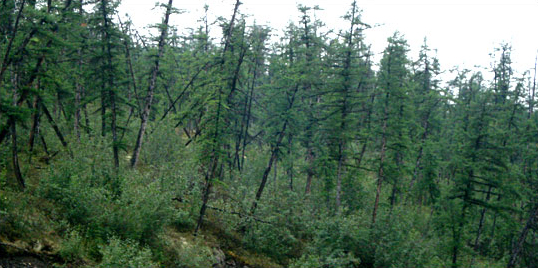
Permafrost zones can also have trees which have their root systems in the layer of soil above the permafrost. When the permafrost underneath melts, the ground shifts unevenly, causing trees to tilt as can be seen on this photo by Jon Ranson of an affected larch forest.
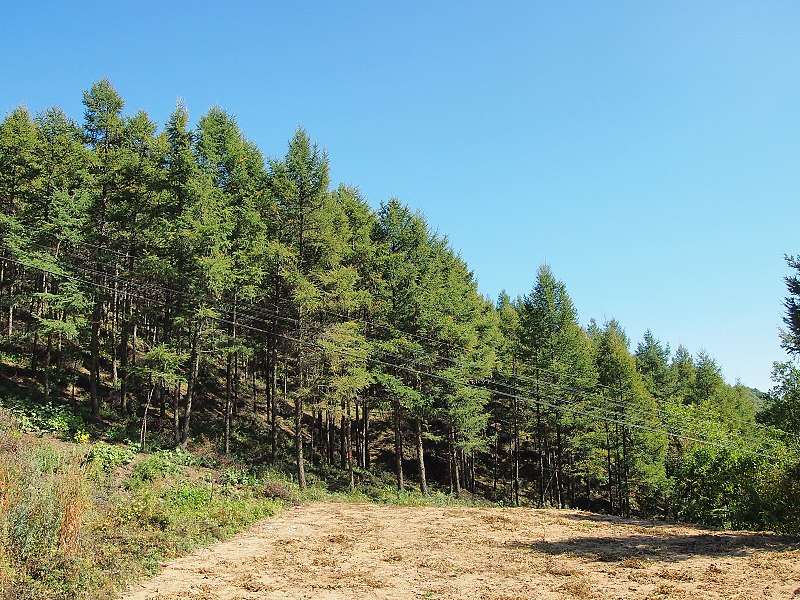
Just for comparison, here is a photo by rheins showing a larch forest not affected by permafrost thawing. The trees look much straighter.
Here is an article in the National Geographic from 2014-04-17 on this topic
Various models exist to calculate the effect of carbon dioxide on global temperatures. They generally show that increasing carbon dioxide concentrations in the atmosphere leads to temperature increases. Such models are far too complex to understand even for most people with a science background (such as myself), let alone people with no science background. They also have a lot of uncertainty. That uncertainty comes from the difficulties posed by modelling clouds. There is a short English language article in Der Spiegel on this. The German language print version is more comprehensive. But in a nutshell, clouds can both trap heat (warming effect) and reflect sun light (cooling effect). But there are many different types of clouds and they trap heat and reflect sunlight differently. What kind of clouds we end up with is affected by such things as the turbulence created by wind going past mountains. All of that is devilishly difficult to model.
Nevertheless, there is still some common sense reasoning that regular people can apply to this aspect of the evidence. Firstly, let's consider what makes the climate models so complex. It is not the primary warming effects of carbon dioxide (and other greenhouse gases). The physical properties of carbon dioxide are well understood and can be measured in the lab. The reason why the models are so complex is that the warming of the atmosphere from increased carbon dioxide concentrations can lead to more water evaporation and cloud cover which counteracts the warming effect.
The uncertainty in climate modelling is mostly in the compensating effects caused by global warming through green house gases, not in the primary warming effects of the green house gases.
It is also important to remember that the compensating effects prove the primary effects.
Here is an analogy. When people get hot they sweat. The sweat evaporates and that cools us down. But when we see a person sweating because of heat or exertion, we wouldn't assume that the person is comfortably cool because he is sweating. Rather, we would take the sweating of the person as evidence that he is hot, though not as hot as he would be, other things being equal, if he were unable to sweat because of a genetic defect or something like that.
